
Walk into almost any agency right now and you'll find the same quiet panic. AI is going to replace us. The thing we sold for fifteen years, turning a founder's idea into a built, working, polished website, can now be done by a tool over a weekend. If that's the whole job, then yeah, the job is in trouble. We never thought that was the whole job.
The build got cheap. The brand didn't.
Design
17
.
06
.
2026
Patryk Sobczak

The fear is real. It's also aimed at the wrong thing.
The agencies losing sleep are the ones who built their business on execution as the bottleneck. Hand us a brief, wait a few weeks, get back a set of screens. That was the deal. And it worked, because for a long time building was the hard, slow, expensive part. Whoever owned the build owned the relationship.
AI took the build. Not partially. The part of our process that used to eat the most hours, turning an approved direction into clean, responsive, production-ready pages, compressed into something close to instant. We're not going to pretend that didn't happen, and we're not going to mourn it. Watching talented people spend their best hours pushing pixels into place was never the point.
Here's what nobody panicking has stopped to ask: if AI does the part that was always a means to an end, what's left is the part that was the end the whole time.
What clients were actually paying for
A founder doesn't want a website. They want a brand people remember and a product people trust enough to pay for. The website was always just the place those two things showed up.
So we made a bet a while ago. If AI compresses the build, an agency shouldn't fight to keep doing the build. It should pour everything it just got back into the two things that actually move client outcomes: a brand that's genuinely different from the seventeen competitors in the same category, and technical execution clean enough that the brand survives contact with a real, growing product. Differentiation and craft. Everything else was overhead we'd all gotten used to.
That sounds nice as a manifesto. The interesting part is what it does to the math of a project.
Ploy.ai, and the ratio that flipped
Take the work we did with Bryant on Ploy.
A normal brand project, the old kind, had a brutal ratio. Maybe twenty percent of the time went to the actual idea, the concept, the thing that made the brand this and not some neighboring version of it. The other eighty percent went to execution. Building it out, making it real, getting it shipped. The good stuff got squeezed because the boring stuff was expensive.
On ploy, that ratio flipped.
We spent weeks on the brand. Weeks. Not because we were slow, but because we finally had the room to be that deliberate. Bryant came in with a sharp vision for what Ploy needed to be, and instead of spending most of our hours figuring out how to get something on a screen, we spent most of them figuring out whether the brand was right. The build that used to swallow eighty percent of the budget wasn't the constraint anymore, so the concept got the eighty percent instead. That is the entire shift in one project. The expensive part became cheap, and the valuable part finally got the time it always deserved.
You can feel the difference in the result. A brand that got eighty percent of the attention looks like one. It's not a template with a logo dropped on top. It's a point of view.
A platform you can actually build on
Then we did the obvious thing. We hosted ploy.ai on Ploy.
There's a neat symmetry to an AI-native website platform running its own front door on itself, but that's not why it mattered. It mattered because of what we handed over at the end: a clean component library, built right, that the team can keep building on without us.
This is the part agencies tend to skip, and it's the part that decides whether a website ages well or falls apart. A site assembled fast, with no shared logic underneath, drifts. Spacing goes slightly off. A new section looks almost-but-not-quite like the last one. Six months in, the thing looks like five different people built it, because in a sense they did. Every quick addition was a separate decision with no memory of the one before it. We’ve seen this across every Webflow and Framer site we’ve built. And Tonik has built hundreds.
A real component library is the memory. It's the set of rules that lets the next page, and the page after that, feel like they belong, without anyone having to think hard about it. So when Ploy ships its next batch of pages, on Ploy, the brand holds. No drift. Ploy’s website platform knows how to refactor components so our clients can rely on it for on-brand, scalable web builds.
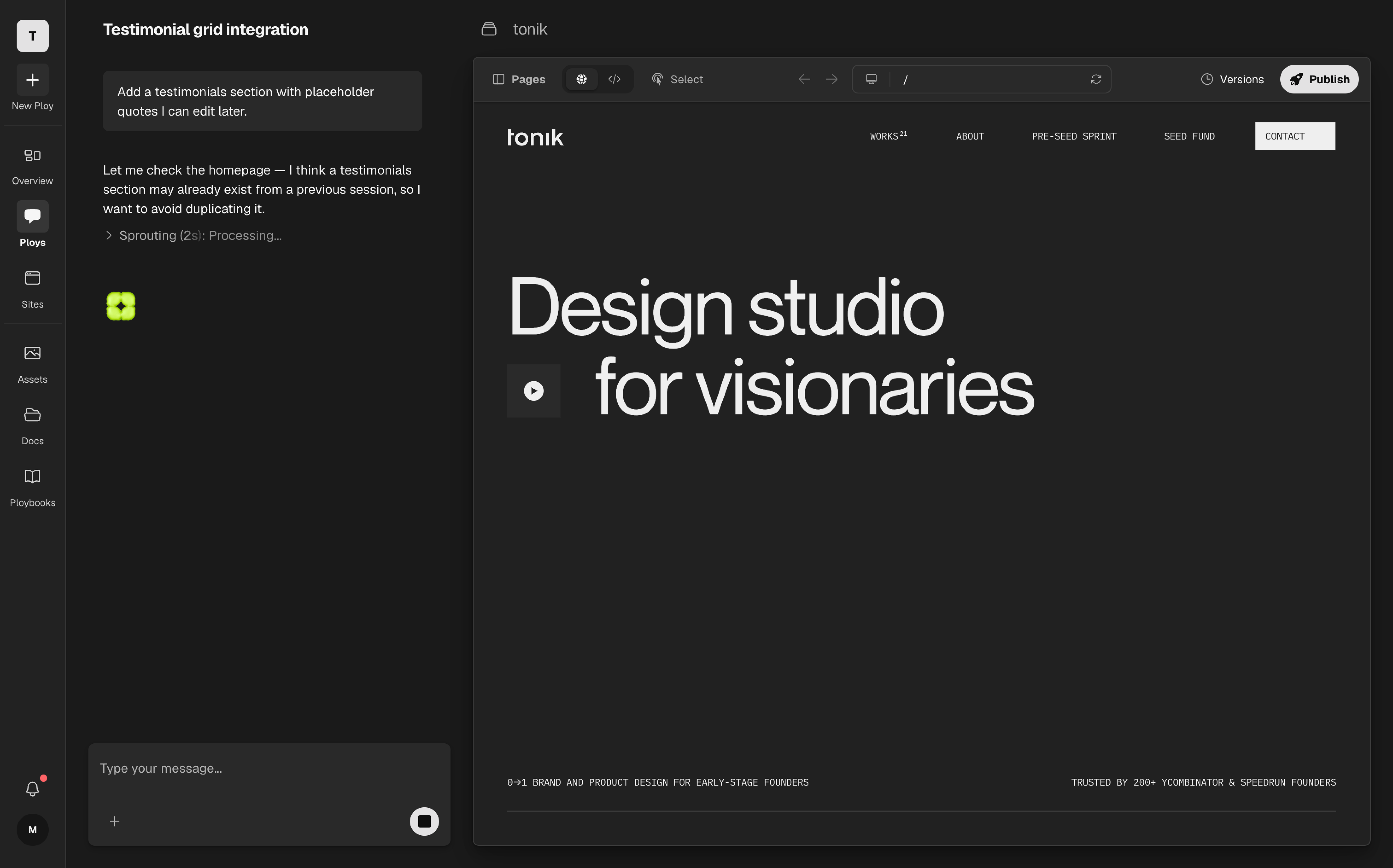
This is the collaboration we want
We've built over two hundred startup websites and brands. Enough to know which parts of the process were genuinely valuable and which were just expensive habits everyone agreed to tolerate.
The version where AI handles the build, the agency goes deep on brand and systems, and the client walks away with something they can actually grow on their own, is better. Better for the founder, who gets more brand and less waiting. Better for our designers, who spend their days on the work that drew them to this in the first place. The fear had it backwards. AI didn't take the interesting work. It took the work that was getting in the way of it.
We can't wait to build the next generation of websites this way. The ones we'll be proud of in five years are getting designed right now, on Ploy.
If you're sitting on a brand that deserves more than the leftover twenty percent, our inbox is open.


